

Selling a Home in The Villages® From Out of State: A Complete Guide
Selling a home in The Villages® while living in another state can feel overwhelming—especially when the sale involves the death of a parent or spouse, an inherited property, a trust, a power of attorney, probate, a move into assisted living, or a house full of belongings that still needs to be cleaned out and prepared for market.
Over more than 20 years working in The Villages® real estate market, I have helped many families handle these situations from hundreds or even thousands of miles away.
Some have mailed me a key.
Others have given me a garage code or arranged for a neighbor to let me into the home.
In many cases, I have never met the trustee, heir, personal representative, or family member in person before beginning the process.
The common question is usually:
“How do we handle all of this when we don’t live in Florida?”
The answer is that much of the process can be handled remotely—but the key is getting the right things in the right order.
Before worrying about photography, staging, repairs, or even listing price, I want to know:
Who legally has the authority to sell the property?
That question can save weeks or even months of problems later.
This guide explains how I approach long-distance home sales in The Villages®, including probate, trusts, powers of attorney, title work, clean-outs, repairs, senior-living transitions, marketing, electronic signatures, and remote closings.
Important: I am a real estate broker, not an attorney, and this article is intended as general real estate information rather than legal advice. Probate, trusts, powers of attorney, Florida homestead law, and estate administration can be complex. I regularly involve qualified title professionals and attorneys when legal questions arise.
The First Question: Who Has the Legal Authority to Sell the Home?
When an owner has died or become incapacitated, one of the biggest mistakes a family can make is assuming that the person managing the situation automatically has authority to sell the property.
Sometimes they do.
Sometimes they do not—at least not yet.
The answer can depend on:
- How the property is titled
- Whether there is a surviving spouse
- Whether the property is held in a trust
- Whether there is a valid power of attorney
- Whether the owner is living or deceased
- Whether probate is required
- Whether a personal representative has been formally appointed
- Whether the property was Florida homestead
- Whether there are multiple heirs or beneficiaries
- Whether probate occurred in another state
This is why I strongly prefer to address ownership and title questions before a home goes under contract—and often before it is listed at all.
A title problem discovered on day one is usually manageable.
A title problem discovered three days before closing can affect buyers, sellers, lenders, movers, rate locks, appraisals, inspections, and everyone else involved.
What Happens When a Married Homeowner Dies?
When a married couple owns a home together and one spouse passes away, the surviving spouse may be able to continue as the owner without probate—but it depends on exactly how title was held.
Florida property owned by spouses as tenants by the entirety, for example, generally includes survivorship rights. Other forms of ownership can also include survivorship provisions.
However, families should never simply assume:
“They were married, so the surviving spouse automatically owns everything.”
The deed needs to be reviewed.
Florida homestead and inheritance rules can also affect certain situations, particularly where there are children from prior relationships, individually titled property, trusts, or other estate-planning arrangements.
That is why one of the first things I often do is look at the current deed and involve the title company if anything is unclear.
The title company may also require a certified copy of the death certificate and other documentation to establish the death and properly address the deceased owner’s interest.
The exact requirements depend on the way title was held and the circumstances of the estate.
My philosophy is simple:
Let’s determine what will be needed at closing before we have a buyer waiting for us to produce it.
Probate: A Will Is Not the Same as Legal Authority to Sell
Probate is often misunderstood.
A will can identify who a deceased person wanted to receive property and may nominate someone to serve as personal representative.
But being named in a will does not necessarily mean that person immediately has authority to sign a listing agreement, execute a sales contract, or convey the property.
In Florida, a personal representative generally receives authority through the probate process and formal court appointment. Florida law sets out preferences for appointment and the administration of estates.
Depending on the circumstances, probate may involve:
- Filing the will
- Opening an estate
- Appointing a personal representative
- Issuing letters of administration
- Identifying assets
- Providing required creditor notices
- Resolving claims
- Addressing homestead issues
- Determining heirs or beneficiaries
- Obtaining any necessary authority to sell estate property
- Ultimately distributing estate assets
Some estates proceed relatively smoothly.
Others take much longer.
The length of the process can depend on the complexity of the estate, creditor issues, family disputes, real estate ownership, out-of-state probate, missing documents, and other factors.
For that reason, I generally do not recommend making assumptions about a deceased owner’s property until the appropriate attorney and title professionals have determined who can legally act.
That does not mean nothing can be done while probate is underway.
We may still be able to:
- Evaluate the property
- Prepare a comparative market analysis
- Assess its condition
- Determine what should happen with the furniture
- Develop a repair plan
- Obtain estimates
- Begin organizing documents
- Prepare a marketing strategy
But the legal authority to sign and sell needs to be established correctly.
A Power of Attorney Ends When the Person Dies
This is one of the most important points for families to understand.
A power of attorney terminates when the person who granted it dies.
Florida law expressly provides that a power of attorney terminates upon the principal’s death. A non-durable power of attorney may also terminate upon incapacity, while a durable power of attorney is specifically designed to remain effective through certain incapacity situations, subject to the document and Florida law.
That means someone cannot say:
“I have Mom’s power of attorney, so I can sell the house after she dies.”
Once the principal dies, the authority must come from somewhere else—such as survivorship rights, a trust, probate, or another legally recognized mechanism.
When a Power of Attorney Can Be Extremely Helpful
While someone is alive, a properly drafted durable power of attorney can be extremely valuable.
This often comes into play when an older homeowner:
- Has become mentally or physically incapacitated
- Moves into assisted living
- Enters memory care
- Can no longer manage finances or real estate matters personally
An adult child or other trusted individual may be authorized to act on that person’s behalf.
However, I never assume that simply because someone says:
“I have power of attorney.”
that every requirement has been satisfied.
Not all powers of attorney are the same.
The document should be reviewed to confirm that it is valid and that it contains the necessary authority for the transaction.
Whenever I am involved in a sale using a power of attorney, I prefer to have the title company review the document at the beginning.
There is another important practical issue: while copies of powers of attorney can often be used for many purposes, Florida law provides that an original power of attorney relied upon to affect title to real property may be required for recording in the official records.
So if the original document is sitting in a safe-deposit box in another state—or cannot be located—that is something I want to know early.
Case Study #1: The Power of Attorney Was Fine—But the Title Search Found Another Problem
One transaction taught me just how valuable early title work can be.
I was working with a former customer who held power of attorney for a woman who was mentally incapacitated.
Rather than simply accepting the document and moving forward, I had the power of attorney reviewed by the title company.
The power of attorney itself was acceptable.
But I decided to go one step further and look more closely at the title history.
That additional review revealed something important:
The owner had previously been divorced.
Because of that history, documentation related to the divorce was going to be required to satisfy the title requirements for the sale.
Had we not investigated this until shortly before closing, we could have been scrambling to locate old court records while a buyer, lender, and everyone else waited.
Instead, we knew about the issue before it became an emergency.
That experience reinforced one of my core beliefs:
Complicated transactions should be investigated on the front end—not at the closing table.
I would rather uncover a potential issue before listing than find it after inspections, appraisal, financing, moving arrangements, and closing dates have already been scheduled.
Trusts Can Make Property Transfers Much Easier
A properly drafted and funded trust can often make handling real estate after a death considerably easier.
The key phrase is:
Properly funded.
Creating a trust is not enough by itself.
The property generally needs to actually be titled in the trust, or otherwise properly connected to the estate plan.
When a trust owns the property and the person serving as trustee dies or becomes unable to act, the successor trustee can often step into the role established by the trust and continue administering the property according to its terms.
This frequently allows trust-owned property to avoid probate as to that asset.
But I would not simply say:
“There’s a trust, so everything is fine.”
I still want to review:
- How the deed is titled
- The relevant trust documentation
- Who the current trustee is
- Whether a successor trustee has properly assumed authority
- Whether there are restrictions on the sale
- What the title company will require
- Whether a certified death certificate or other documentation will need to be provided
Trusts are one of the reasons I like involving title professionals early.
A well-structured trust can simplify things tremendously.
But the trust and the title still need to match.
Why I Have Trusts and Powers of Attorney Reviewed Before Listing
Whenever a transaction involves:
- A trust
- A power of attorney
- A deceased owner
- A prior divorce
- Multiple owners
- Out-of-state probate
- An unusual deed
- A discrepancy in names
I often involve the title company before we get too far.
In some cases, I will recommend having preliminary title work performed as well.
Why?
Because my goal is to dot every i and cross every t.
The average real estate transaction may not uncover a problem until the title commitment is being prepared after a contract is signed.
In a complicated estate or authority situation, I prefer to ask the questions before there is a buyer depending on us.
Probate in Another State May Not Be Enough for Florida Real Estate
This issue catches some families completely by surprise.
Imagine that Dad lived in Pennsylvania.
He passes away.
The family opens probate in Pennsylvania.
Everything appears to be handled.
But Dad also owned a home in The Villages®.
Because the real estate is physically located in Florida, additional Florida estate proceedings or title requirements may still be necessary.
Florida law provides for ancillary administration when a nonresident dies owning assets in Florida, subject to the circumstances of the estate.
That does not mean every out-of-state estate follows exactly the same procedure.
It means the family should not assume that probate in another state automatically resolves title to Florida real estate.
Case Study #2: Probate Was Completed in Pennsylvania—but the Florida Property Still Had a Problem
I once represented a buyer purchasing a home in The Villages®.
While reviewing the transaction documents, something caught my attention.
The name being used by the seller on the disclosures was very similar to the way ownership appeared in the property records—but it was not exactly the same.
It was subtle.
But after more than 20 years in real estate, small inconsistencies sometimes cause me to ask larger questions.
I asked the listing agent about it.
That is when I learned that the owner’s father had died.
That immediately caused me to ask:
Has the Florida property been properly addressed through the estate?
The family had already handled probate in Pennsylvania.
But it eventually became clear that additional work was required in Florida before clear title to the property could be conveyed.
My buyer was already under contract.
Rather than allowing the transaction to collapse, I became actively involved in helping the parties find a path forward.
I used local contacts to help connect the Pennsylvania attorney with a Florida attorney so they could address the Florida-specific estate and title issues.
Ultimately, the professionals were able to work together and the transaction made it to closing.
The lesson from that transaction was extremely important:
Completing probate in a person’s home state does not necessarily mean Florida real estate has been fully addressed.
Florida has its own procedures involving property owned by nonresident decedents.
As a Realtor, I am not there to practice probate law.
But I do believe an experienced real estate professional should recognize warning signs, ask the right questions, and know when it is time to bring attorneys and title professionals into the conversation.
Case Study #3: Why Legal Authority Should Be Confirmed Before a Property Is Listed
Another transaction involved one of my agents representing a buyer.
A home had been placed on the market after the owner died.
A family member had flown into town and believed he had authority to handle the sale because there was a will.
The property was listed.
My agent’s buyer entered into a contract.
The transaction then progressed significantly.
The buyer:
- Paid for inspections
- Began the mortgage process
- Had an appraisal ordered
- Had a survey ordered
- Made plans around purchasing the property
Later, it was determined that the person handling the sale did not yet have the legal authority necessary to complete the transaction, and probate still needed to occur.
At that point, the situation became much more complicated.
An interim occupancy arrangement was created so the buyer could temporarily occupy the home while the legal process continued.
Arrangements were also made allowing the buyer to handle the liquidation of furniture and personal property.
Everyone hoped the probate process would be resolved quickly enough to complete the purchase.
But it took months.
Meanwhile, the buyer’s mortgage situation became increasingly difficult.
Interest rates were changing, the rate-lock situation became more expensive and uncertain, and there was still no clear closing date.
Eventually, the buyer decided the uncertainty had gone on too long.
The buyer moved out and purchased another property.
Naturally, the family selling the home was disappointed.
The buyer was frustrated.
Everyone involved had invested time, energy, and money.
But the root of the problem existed before the buyer ever wrote an offer:
The person handling the sale had not yet established the legal authority necessary to complete it.
This is why I believe so strongly in handling these questions at the beginning.
It does not mean a family has to sit still while probate proceeds.
We can often prepare the property, evaluate value, organize a clean-out, and develop a marketing plan.
But before representing to the market that a home can be sold, I want to understand who actually has the authority to sell it and what must happen to convey clear title.
Before Listing an Inherited or Estate Property in The Villages®
Here are some of the questions I like answered early:
1. Who is currently shown as the owner on the deed?
2. Has one of the owners died?
3. Was the owner married?
4. Is there a surviving spouse?
5. Is the property titled in a trust?
6. Is someone relying on a power of attorney?
7. Is the person who granted the power of attorney still alive?
8. Is there merely a will, or has a personal representative actually been appointed?
9. Was probate completed in another state?
10. Does Florida ancillary probate or another Florida procedure need to be considered?
11. Has a title professional reviewed the ownership history?
12. Are certified death certificates, trust documents, original powers of attorney, court orders, or other records available?
Answering these questions early can save an enormous amount of time later.
You May Not Need to Travel to Florida for Me to Evaluate the Home
One of the most common concerns I hear from families is:
“We live in Ohio. Do we need to fly back down just so you can look at the house?”
Often, the answer is no.
I have evaluated many homes without meeting the trustee, heir, personal representative, or family member face-to-face.
I simply need authorized access.
That may come through:
- A key mailed to me
- A garage-door code
- A lockbox
- A neighbor
- A friend
- A local family member
Once I am inside, I can personally assess the home.
I look at:
- Overall condition
- Floor plan
- Location within The Villages®
- Roof age
- HVAC
- Water heater
- Flooring
- Kitchen
- Bathrooms
- Appliances
- Windows
- Exterior condition
- Landscaping
- Lanai
- Garage and golf-cart garage
- Updates
- Deferred maintenance
- Furniture
- Personal property
- Comparable sales
- Active competition
- Pending competition
- Bond balance when relevant
From there, I can prepare a comparative market analysis and review everything remotely by phone, email, or video call.
Should You Sell the Home Furnished or Empty?
This is especially important in The Villages®.
Many homes here are sold:
- Furnished
- Partially furnished
- Turnkey
- Unfurnished
There is no universal answer.
When I walk through the property, I evaluate whether the existing furnishings help or hurt the home.
Good furniture can:
- Help define spaces
- Make rooms feel welcoming
- Appeal to seasonal or relocating buyers
- Reduce the family’s clean-out burden
On the other hand, too much furniture or dated furniture can:
- Make rooms appear smaller
- Distract from the home
- Hurt photography
- Make the property feel older
Sometimes I recommend leaving most of the furnishings.
Sometimes I recommend clearing almost everything out.
Other times, we remove excess furniture and strategically stage what remains.
The right decision should be based on what gives the property the best chance of selling successfully, not simply what is easiest.
What If the House Is Full of a Parent’s Belongings?
This is one of the hardest parts emotionally and logistically.
A family may be several states away while the home contains:
- Furniture
- Clothing
- Family photographs
- Artwork
- China
- Kitchenware
- Tools
- Golf equipment
- Important papers
- Electronics
- Decades of personal belongings
Families often tell me:
“We don’t even know where to start.”
I work with experienced local professionals who can help families manage the process.
Depending on the situation, that can include:
- Sorting
- Packing
- Shipping family keepsakes
- Organizing belongings
- Cleaning
- Decluttering
- Selling appropriate items through Facebook Marketplace or other outlets
- Coordinating donations
- Removing unwanted furniture
- Staging the home
- Preparing the property for photography and showings
The objective is not simply:
“Throw everything away.”
It is to develop a thoughtful plan for:
What stays?
What goes to family?
What gets sold?
What gets donated?
What helps us sell the house?
Having someone local coordinate these pieces can dramatically reduce the number of trips an out-of-state family has to make.
Repairs Can Also Be Managed Long Distance
Many families inherit a home that needs work.
The carpet may need replacing.
The landscaping may be overgrown.
The house may need:
- Painting
- Pressure washing
- Cleaning
- Flooring
- Appliance replacement
- Handyman repairs
- Plumbing work
- Electrical work
- HVAC servicing
- Roof evaluation
- Screen repairs
- Landscaping
Living out of state makes coordinating multiple vendors difficult.
Over the years, I have developed local relationships that allow me to help coordinate many of these needs.
But I also do not believe every seller should renovate everything.
The real question is:
Will the money we spend improve marketability or the seller’s net result enough to justify the expense?
Sometimes a relatively small investment can transform how a home presents.
Other times, a large renovation will not produce an adequate return.
That is where market knowledge matters.
Sometimes the Home Sale Begins With a Senior-Living Transition
Not every long-distance sale begins after someone dies.
Sometimes Mom or Dad is alive but can no longer safely remain at home.
The family may suddenly be trying to determine:
- Does Mom need independent living?
- Assisted living?
- Memory care?
- Skilled nursing?
- What happens to the house?
- Who handles the furniture?
- Who manages the move?
I maintain relationships with professionals in Central Florida who specialize in helping families navigate senior-living options.
I often describe this type of professional as similar to having a real estate agent for senior living.
They understand:
- Independent-living communities
- Assisted-living communities
- Memory-care options
- Nursing and skilled-care environments
- Local resources
They can be an extraordinary source of information for adult children trying to make decisions from another state.
My role is not to determine someone’s medical needs.
But part of providing good service is knowing who to call when a family needs help outside my area of expertise.
Electronic Signatures Make Long-Distance Sales Much Easier
Twenty years ago, handling a transaction remotely was much more cumbersome.
Today, electronic signing platforms allow most real estate documents to be reviewed and signed without being physically present.
This can include:
- Listing documents
- Seller disclosures
- Contracts
- Addenda
- Inspection responses
- Amendments
- Closing-related paperwork that is eligible for electronic execution
We can communicate through:
- Phone
- Text
- Video conference
- Electronic signatures
A seller does not generally need to fly to Florida every time a document needs to be signed.
Title Work Is Especially Important in Long-Distance and Estate Sales
Title issues can arise in any transaction.
But I pay particular attention when I see:
- A deceased owner
- Probate
- A trust
- A power of attorney
- A prior divorce
- Multiple heirs
- Multiple owners
- Name discrepancies
- Old mortgages
- Liens
- Judgments
- Homestead questions
- Out-of-state estate proceedings
I also own Priority Title Services, which has given me additional insight into the title and closing side of real estate.
Real estate brokerage and title services are separate functions, and consumers have settlement-service choices as allowed by their contracts and applicable law.
But my experience in both areas has reinforced a very simple belief:
It is better to discover title problems early.
Depending on the circumstances, I may recommend:
- Reviewing the deed
- Reviewing a trust
- Reviewing a power of attorney
- Performing preliminary title work
- Obtaining certified death certificates
- Locating an original power of attorney
- Locating divorce documents
- Coordinating with a probate attorney
- Resolving old liens or mortgages
Some documents may ultimately need to be recorded in the county’s official records.
For example, Florida law provides that an original power of attorney relied upon to affect title to real estate may be required for recording.
The exact death-certificate and recording requirements will depend on the ownership and title circumstances, which is why I let the title professionals determine exactly what is required rather than using a one-size-fits-all checklist.
Can You Close Without Coming Back to Florida?
In many cases, yes.
A large portion of seller closing documents can often be handled electronically.
Certain documents—particularly deeds and other documents that will be recorded—have specific signing, witnessing, and notarization requirements.
A title company can often arrange an approved signing process where the seller lives.
That may include sending a notary or coordinating another permitted remote or mobile signing arrangement.
The important thing is to plan ahead.
I want to know well before closing:
- Where the seller will be
- Whether anyone is traveling internationally
- Who is signing
- Whether a trust or power of attorney is involved
- What original or certified documents are required
- Which documents require notarization
- How the deed will be signed
- How proceeds will be delivered
That reduces surprises.
A Real Client Experience: Selling a Family Home From Ohio
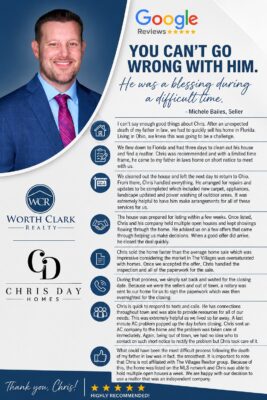
One of the best examples of how this process can work comes from a recent client, Michele Bailes.
After the unexpected death of her father-in-law, Michele and her family suddenly had to deal with his Florida home while living in Ohio.
They came to Florida with only a few days to clean out the property and find a Realtor.
Once they returned to Ohio, I helped coordinate the rest of the process locally.
That included:
- Preparing the home for sale
- New carpet
- Appliance updates
- Landscaping
- Pressure washing
- Coordinating repairs
- Marketing the property
- Holding multiple open houses
- Reviewing offers
- Handling inspection-related matters
- Coordinating an unexpected air-conditioning issue
- Helping facilitate a remote closing
Michele described the experience this way:
“You can’t go wrong with him. He was a blessing during a difficult time.”
She also explained that because the family lived in Ohio, having someone locally who could coordinate contractors, repairs, marketing, paperwork, and unexpected issues made an enormous difference.
Her full Google review describes how her family was able to return home while I handled the property here in Florida through the sale and closing.
Read Michele’s full Google Review:
https://share.google/oCQua0JQYk9t2atHB
A Practical Step-by-Step Guide to Selling a Home in The Villages® From Another State
Step 1: Determine ownership and authority
Before listing, determine:
- Who is on the deed
- Whether an owner has died
- Whether there is a surviving spouse
- Whether the home is in a trust
- Whether probate is required
- Whether a personal representative has been formally appointed
- Whether someone is acting under a power of attorney
- Whether probate occurred outside Florida
Bring in a Florida attorney or title professional when necessary.
Step 2: Get access to the property
Access can often be arranged through:
- Mailed key
- Garage code
- Neighbor
- Local friend
- Lockbox
- Authorized family member
You may not need to travel just for the initial evaluation.
Step 3: Complete a market and condition assessment
I inspect the property and prepare a comparative market analysis.
We discuss:
- Probable value
- Market competition
- Condition
- Repairs
- Furnishings
- Clean-out
- Staging
- Pricing strategy
This can all be reviewed remotely.
Step 4: Decide what to do with personal property
Create categories:
Keep
Ship
Sell
Donate
Discard
Then determine whether the home should ultimately be:
- Furnished
- Partially furnished
- Staged
- Empty
Step 5: Make only the repairs that make financial sense
Prioritize repairs that improve:
- First impression
- Insurability
- Marketability
- Buyer confidence
- Photography
- Net return
Avoid renovating simply because someone says everything needs to be “updated.”
Step 6: Prepare professional marketing
Depending on the property, marketing may include:
- Professional photography
- Floor plans
- Video
- MLS exposure
- Major real estate websites
- Social media
- Open houses
- Agent networking
- Direct buyer inquiries
Living out of state should not mean accepting weaker marketing.
Step 7: Review offers remotely
Price is only part of the decision.
Evaluate:
- Cash versus financing
- Deposit
- Inspection terms
- Financing contingencies
- Requested concessions
- Closing timeline
- Personal property
- Net proceeds
- Probability of closing
Step 8: Manage inspection and appraisal
Local access and contractor relationships make it possible to handle:
- Inspections
- Repair estimates
- Appraisal
- Reinspection
- Final walkthrough preparation
without requiring the seller to return to Florida.
Step 9: Complete title work early
Particularly with an estate, trust, or power of attorney, provide requested documents as early as possible.
That may include:
- Deed
- Trust documents
- Power of attorney
- Certified death certificate
- Letters of administration
- Probate documents
- Divorce decree
- Mortgage information
- Other title-related documentation
Step 10: Coordinate a remote closing
Confirm signing requirements well in advance.
Most sellers should not assume that physically appearing in Florida is required.
A title company can explain which documents can be signed electronically and which require notarization or other formal execution.
Documents You May Want to Locate Early
Not every transaction requires all of these, but gathering relevant documents early can help:
- Current deed
- Will
- Trust or certification of trust
- Original power of attorney
- Certified death certificates
- Letters of administration
- Probate court orders
- Divorce decree
- Mortgage information
- Survey
- Roof permits or warranties
- HVAC records
- Receipts for improvements
- Insurance documents
- Keys and garage remotes
- Golf-cart documentation if applicable
Do not panic if you cannot find everything.
The point is to identify what may be needed early enough to solve problems.
Common Mistakes Families Should Avoid
Mistake #1: Assuming a will equals immediate authority
A will may nominate a personal representative, but formal probate steps may still be necessary.
Mistake #2: Trying to use a power of attorney after death
Florida law provides that a power of attorney terminates when the principal dies.
Mistake #3: Assuming probate in another state automatically clears Florida property
Florida may require ancillary or other proceedings when a nonresident dies owning Florida assets.
Mistake #4: Waiting until closing to review complicated title issues
This is one of the most avoidable problems.
Mistake #5: Spending too much on renovations
Do the work that improves the result—not work simply for the sake of updating.
Mistake #6: Automatically emptying the home
Furniture may help or hurt depending on the property.
Mistake #7: Making unnecessary trips to Florida
Many parts of the sale can be handled remotely.
Mistake #8: Waiting until the house is “ready” before calling a Realtor
For complicated situations, an experienced Realtor may be most valuable before the property is ready.
Frequently Asked Questions
Can I sell a home in The Villages® if I live in another state?
Yes. Many aspects of the transaction can be handled remotely, including market analysis, listing documents, offer negotiation, contractor coordination, inspections, and much of the closing process.
Can I sell my deceased parent’s home in The Villages®?
Possibly, but the first step is determining who has legal authority.
The answer depends on how the property was titled, whether there is a trust, whether probate is necessary, whether there is a surviving spouse, and other estate factors.
Does a will let me immediately sell my parent’s house?
Not necessarily.
A will does not automatically substitute for formal appointment and authority through the probate process.
Does power of attorney work after death?
No. Florida law provides that a power of attorney terminates when the principal dies.
What if my parent was incapacitated but is still alive?
A valid durable power of attorney may allow an authorized agent to handle certain real estate matters, depending on the document and circumstances.
The title company should review the power of attorney early.
Do I need the original power of attorney?
Potentially.
Florida law states that an original power of attorney relied upon to affect title to real property may be required for recording in the official records.
Will I need a death certificate?
When an owner has died, the title company will typically determine what death documentation is required based on how the property was titled and the estate circumstances. This commonly involves a certified copy of the death certificate rather than simply an informal photocopy.
Does a trust avoid probate?
A properly created and funded trust can often allow trust-owned assets to be administered without probate as to those assets.
The deed and trust documents still need to be reviewed to confirm ownership and successor-trustee authority.
What if probate was already completed in another state?
Do not assume that automatically resolves Florida real estate.
Florida law provides procedures for ancillary administration when a nonresident dies leaving assets in Florida.
Do I have to come to Florida to list the property?
Usually not.
Electronic signatures and remote communication make it possible to handle most listing documentation long-distance.
What if the house is full of furniture?
I can help evaluate whether the home should be sold furnished, partially furnished, staged, or empty, and help coordinate local professionals for packing, selling, donating, removing, cleaning, and staging items.
Can repairs be handled remotely?
Yes.
With seller authorization, many repair and preparation tasks can be coordinated locally.
Do I have to attend closing in person?
Often not.
Many seller documents can be handled electronically or through coordinated notarized signing arrangements. The title company should confirm the specific requirements for each transaction.
Why Experience Matters More in These Transactions
A straightforward home sale can become complicated quickly when it involves:
- Death
- Probate
- Trusts
- Powers of attorney
- Incapacity
- Out-of-state heirs
- Long-distance ownership
- Personal property
- Contractors
- Senior-living transitions
- Title issues
The Realtor does not replace the attorney.
The Realtor does not replace the title company.
But an experienced Realtor should know enough to recognize when something deserves closer attention.
That is the difference between saying:
“Let’s put it on the MLS and figure it out later.”
and saying:
“Before we list this, let’s make sure we understand who owns it, who can sign, what title will require, and what issues we can solve now.”
After more than 20 years working in The Villages® real estate market and more than 1,000 homes sold in the area, I have learned that the smoothest transactions are often the ones where the most difficult questions are asked early.
Selling From Out of State Does Not Mean You Have to Handle Everything Yourself
Maybe you are in Ohio trying to sell your father’s home.
Maybe your mother has moved into memory care.
Maybe you are a successor trustee.
Maybe you have been nominated as personal representative.
Maybe the house is still full of furniture and you do not know where to begin.
Maybe you inherited a home in The Villages® but have never even been inside it.
You do not necessarily need to make repeated trips to Florida.
The process can often be broken down into manageable steps:
Establish authority.
Confirm title.
Assess the property.
Determine what to do with the contents.
Make smart repairs.
Prepare and market the home.
Manage the contract locally.
Coordinate closing remotely.
Sometimes the first step is not signing a listing agreement.
Sometimes the first step is simply figuring out:
What needs to happen next?
That is a conversation I am happy to have.