

A Consumer’s Guide to Choosing the Right Marketing Strategy for Your Home
Prepared by Chris Day
Managing Broker | Worth Clark Realty
20+ Years of Experience | Over 1,000 Homes Sold
Last Updated: August 2026
Disclosure
I spent 14 years with Properties of The Villages® before joining an MLS brokerage nearly seven years ago. The observations shared in this guide are based on my firsthand experience working within both business models and are intended to educate homeowners about the different marketing approaches available when selling a home in The Villages®.
This guide is not intended to criticize any brokerage or individual Realtor®. Instead, its purpose is to help homeowners understand the differences between two marketing systems so they can make informed decisions based on their own goals, priorities, and circumstances.
Real estate has changed dramatically over the past two decades. Technology, buyer behavior, digital marketing, and communication tools continue to evolve, and I believe homeowners deserve current, objective information before deciding how to market one of their largest financial assets.
The Company You Choose Matters.
The REALTOR® You Choose Matters Even More.
Choosing a brokerage is important.
Choosing the REALTOR® who represents your interests may be even more important.
Every company has different marketing platforms, technology, reporting tools, communication styles, and philosophies. Likewise, every real estate professional brings different levels of experience, negotiation skills, ethics, responsiveness, and local market knowledge.
Throughout this guide, I’ll compare two different marketing approaches. However, I also encourage homeowners to focus on the individual professional they choose to represent them—not just the company they work for.
The right combination of marketing, communication, experience, technology, and representation can make a meaningful difference throughout the selling process.
Table of Contents
- Why I Wrote This Guide
- My Experience with Both Business Models
- REALTOR® vs. Real Estate Agent
- Single Agent vs. Transaction Brokerage
- MLS vs. Properties of The Villages® at a Glance
- Marketing Exposure
- National Website Syndication
- Buyer Reach & Relocation Referrals
- Modern Marketing vs. Traditional Marketing
- Open Houses
- Seller Reporting & Transparency
- Showing Technology
- Signage & Buyer Accessibility
- Which Marketing Strategy Is Right for You?
- Final Thoughts
Why I Wrote This Guide
One of the questions I’m asked most often by homeowners in The Villages® is:
“Should I sell my home through the MLS or through Properties of The Villages®?”
It’s an excellent question—and one that deserves an honest, thoughtful answer.
Unfortunately, many homeowners receive opinions instead of facts.
Some are told one system is better than the other. Others are encouraged to list with whichever company they’re speaking with at the time.
I believe homeowners deserve something more valuable than a sales presentation.
They deserve an objective explanation of how each marketing platform works, how today’s buyers search for homes, and what questions they should ask before choosing a REALTOR®.
This guide is intended to educate—not persuade.
Both the MLS and Properties of The Villages® have successfully helped thousands of homeowners buy and sell real estate over the years.
However, the real estate industry has changed dramatically.
Twenty years ago, buyers primarily searched through newspaper advertisements, brokerage offices, and by driving neighborhoods looking for yard signs.
Today, buyers overwhelmingly begin their search online using mobile devices, real estate websites, email alerts, social media, GPS navigation, and their REALTOR’S MLS search tools.
Technology has transformed nearly every aspect of selling a home—from photography and video to pricing analytics, showing management, reporting, digital marketing, and communication.
Understanding those changes is essential when deciding how to market one of your largest investments.
My hope is that this guide helps you understand your options so you can confidently choose the marketing strategy and real estate professional that best fit your goals.
MLS vs. Properties of The Villages®
At a Glance
The table below summarizes some of the major differences between the two marketing approaches discussed throughout this guide.
|
Feature |
MLS |
Properties of The Villages® |
|---|---|---|
|
National Exposure |
Syndicates to major real estate websites, IDX sites, brokerage websites, ChrisDayHomes.com, and many additional participating websites. |
Primarily marketed through the company’s own platform. |
|
Representation |
Single Agency or Transaction Brokerage depending on brokerage. I primarily practice as a Single Agent because I believe it provides the highest level of fiduciary representation. |
Transaction Brokerage. |
|
REALTOR® Membership |
REALTORS® voluntarily agree to follow the National Association of REALTORS® Code of Ethics in addition to Florida licensing laws. |
Licensed Florida real estate professionals who are not members of the National Association of REALTORS® and therefore do not subscribe to the REALTOR® Code of Ethics. |
|
Open House Promotion |
MLS syndication, digital marketing, social media, and brokerage promotion. |
Primarily promoted through the company’s newspaper and WVLG 640 AM radio station. |
|
Lockbox Technology |
Supra electronic lockboxes. |
Combination lockboxes. |
|
Seller Reporting |
Weekly ListTrac reports, Online Analytics Reports, ShowingTime reports, Pricing Benchmark Reports, Target Market Analysis, and showing feedback. |
Reporting options vary. |
Important: Marketing practices, technology, and brokerage policies can change over time. This comparison reflects my professional experience and publicly available information at the time this guide was written. Homeowners should always discuss current marketing plans and services directly with any real estate professional they are considering hiring.
My Experience with Both Business Models
One reason I believe I’m uniquely qualified to write this guide is because I’ve had the opportunity to work extensively within both business models.
I spent 14 years with Properties of The Villages®, where I built my career and was honored to become the company’s #1 Pre-Owned Sales Agent in both 2018 and 2019. During those years, I represented hundreds of buyers and sellers, developed lifelong relationships with clients, and gained an in-depth understanding of The Villages® real estate market.
Nearly seven years ago, I transitioned to an MLS brokerage. Today, I serve as the Managing Broker of Worth Clark Realty while continuing to specialize in helping buyers and sellers throughout The Villages® and surrounding 55+ communities.
Working successfully within both systems has given me a perspective that very few REALTORS® can offer.
I’ve experienced the strengths of each model.
I’ve experienced the limitations of each model.
Most importantly, I’ve watched the real estate industry evolve over more than two decades.
This guide isn’t about deciding who is “right.”
It’s about helping homeowners understand how different marketing strategies work so they can make an informed decision based on today’s real estate environment—not yesterday’s.
REALTOR® vs. Real Estate Agent
Is There Really a Difference?
One of the most misunderstood topics in real estate is the difference between a licensed real estate agent and a REALTOR®.
Many people use the terms interchangeably, but they are not the same.
Every REALTOR® is a licensed real estate professional.
However, not every licensed real estate professional is a REALTOR®.
A REALTOR® is a member of the National Association of REALTORS® (NAR) and voluntarily agrees to follow its Code of Ethics in addition to complying with state real estate laws.
The Code of Ethics establishes standards for professionalism, honesty, cooperation, integrity, and the protection of consumers. It promotes cooperation among REALTORS® while helping ensure buyers and sellers are treated fairly throughout the transaction.
For consumers, this means working with someone who has voluntarily agreed to an additional level of professional accountability beyond Florida’s licensing requirements.
Single Agent vs. Transaction Brokerage
Understanding the Type of Representation You’re Receiving
One of the most important decisions you’ll make when selling your home isn’t simply who you hire—it’s how you’ll be represented.
Florida law recognizes several brokerage relationships, but the two you’ll encounter most often are Single Agency and Transaction Brokerage.
Many homeowners sign listing paperwork without fully understanding the difference.
Single Agency
I choose to represent my clients primarily as a Single Agent because I believe my clients deserve the highest level of representation permitted under Florida law.
As a Single Agent, I owe my client fiduciary duties that include:
- Loyalty
- Confidentiality
- Full disclosure
- Obedience to lawful instructions
- Accounting
- Skill, care, and diligence
Simply put, my responsibility is to advocate for my client’s best interests throughout the transaction.
Transaction Brokerage
Many brokerages in Florida, including Properties of The Villages®, commonly conduct business as Transaction Brokers.
A Transaction Broker provides valuable services by facilitating the transaction for both parties but does not owe the same fiduciary duties of loyalty, full confidentiality, or obedience that exist in a Single Agency relationship.
Instead, the Transaction Broker works to assist both parties in reaching a successful closing while remaining neutral.
Neither relationship is inherently right or wrong.
They are simply different forms of representation, and every homeowner should understand those differences before signing a listing agreement.
Marketing Exposure, Buyer Reach & Modern Technology
The Way Buyers Search for Homes Has Changed
One of the biggest differences between selling a home today and selling a home twenty years ago isn’t the homes themselves.
It’s the buyers.
When I began my real estate career, buyers often found homes by reading newspaper advertisements, visiting brokerage offices, or driving neighborhoods looking for “For Sale” signs.
Today, the overwhelming majority of buyers begin their search online.
Whether they’re relocating from another state or simply moving across town, buyers now use websites, mobile apps, email alerts, social media, GPS navigation, and increasingly Artificial Intelligence (AI) search tools to discover available homes.
As buyer behavior has changed, successful marketing strategies have evolved with it.
National Marketing Exposure
One of the greatest advantages of listing a property through the Multiple Listing Service (MLS) is the ability to market the home across numerous real estate platforms rather than relying on a single website or marketing channel.
When a home is entered into Stellar MLS, it may be syndicated to major consumer real estate websites including:
- Zillow
- Realtor.com
- Homes.com
- Redfin
- Individual brokerage websites
- REALTOR® websites such as ChrisDayHomes.com
- Numerous additional participating MLS syndication partners
Rather than depending on one company to generate buyer traffic, the objective is to place the property wherever today’s buyers are already searching.
The broader the exposure, the greater the opportunity for qualified buyers to discover your home.
What is IDX?
You may occasionally hear the term IDX when researching real estate websites.
IDX stands for Internet Data Exchange.
It is the technology that allows participating REALTORS® and brokerages to display live MLS listings directly on their own websites.
For example, buyers visiting ChrisDayHomes.com can search active MLS listings in real time without leaving the website.
This expands a property’s online visibility while allowing buyers to remain connected directly with the listing brokerage.
Today, thousands of real estate websites throughout the country utilize IDX technology.
The result is substantially greater exposure than relying upon a single website alone.
Marketing Insight #1
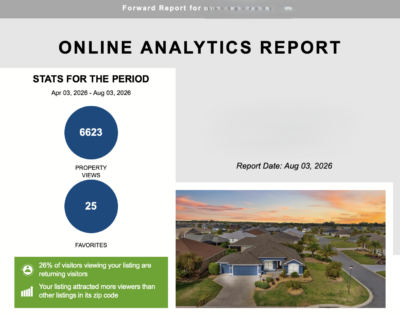
Weekly Online Analytics Report
Insert Figure 1 – Online Analytics Report (Property Address Redacted)
Figure 1. Weekly Online Analytics Report provided to sellers.
One of the promises I make to every seller is simple:
You should never have to wonder whether your home is receiving online exposure.
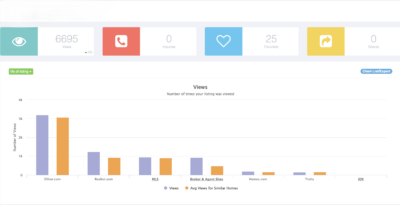
Every Monday my sellers receive a detailed Online Analytics Report summarizing how buyers are interacting with their listing across participating real estate websites.
These reports include:
- Total property views
- Buyer favorites
- Returning visitors
- Website traffic sources
- Geographic buyer locations
- Overall online marketing performance
Rather than simply saying that marketing is working, these reports provide measurable data that allows both the seller and me to evaluate the effectiveness of the marketing campaign.
Chris’ Marketing Insight
One of the first statistics I review each week is returning visitors. When buyers return to view a property multiple times, it often suggests they are seriously considering the home rather than simply browsing listings.
Marketing Insight #2
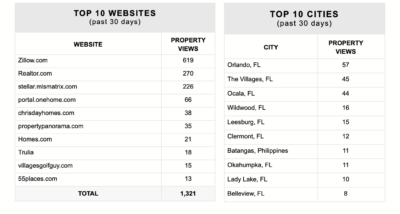
Where Are Buyers Finding Your Home?
Insert Figure 2 – Website Traffic Report (Property Address Redacted)
Figure 2. Website Traffic & Geographic Buyer Report.
Many homeowners assume buyers discover their home through one website.
Today’s buyers don’t.
Some begin on Zillow.
Others use Realtor.com.
Many search Homes.com.
Some receive listings directly from their REALTOR® through MLS email alerts.
Others begin on brokerage websites or REALTOR® websites such as ChrisDayHomes.com.
This report identifies which websites are generating buyer activity and where those buyers are located geographically.
For example, one recent listing generated activity through:
- Zillow
- Realtor.com
- Homes.com
- Stellar MLS
- OneHome
- ChrisDayHomes.com
- Brokerage websites
- Additional MLS syndication partners
It also showed where buyers were located throughout Florida and other markets.
This information helps determine whether the marketing strategy is reaching local buyers, relocation buyers, or both.
Chris’ Marketing Insight
Marketing should never be based on assumptions. Data allows us to evaluate what’s working and make informed decisions throughout the listing period.
Relocation Buyers & REALTOR® Referrals
One of the most overlooked aspects of selling a home is understanding where buyers actually come from.
The Villages® has always attracted buyers from across the United States.
Many homeowners first sell a property in another state before purchasing a home in Florida.
Large real estate companies throughout the country often maintain Relocation Departments that help coordinate those moves.
These departments work with experienced local brokerages to connect buyers with qualified REALTORS® who understand the local market.
Throughout my career I’ve been fortunate to receive referrals from:
- REALTORS® throughout the United States
- Brokerage relocation departments
- Past clients
- Friends and family members of previous customers
In fact, referrals from past clients have become one of the largest sources of my business.
To me, that’s one of the greatest compliments a REALTOR® can receive.
Digital Marketing Has Replaced Traditional Print Advertising
Real estate marketing has changed dramatically during my career.
When I first entered the business, newspaper advertising played a significant role in how buyers searched for homes.
I remember buyers walking into the office carrying newspaper pages with listings they had circled or cut out, much like coupons.
For many years I was one of the largest newspaper advertisers in The Villages®.
At the time, it worked.
As buyer behavior changed, however, something else happened.
The phone stopped ringing from newspaper advertisements.
Buyers had moved online.
Today’s local newspaper is much smaller than it once was, and many younger retirees prefer to receive their news, entertainment, and real estate information digitally.
That shift completely changed how I invest my marketing dollars.
In 2025, I sold more than $30 million in residential real estate.
Not one newspaper advertisement was part of that marketing strategy.
Instead, my marketing budget is invested almost entirely in digital marketing.
One of my agents once made a statement that has stayed with me:
“Tomorrow’s buyers are on the social media platforms.”
I believe that’s exactly right.
Today I actively market listings through:
- Sponsored Facebook advertising
- TikTok
- YouTube
- YouTube Shorts
- ChrisDayHomes.com
- Search engine optimization (SEO)
Each platform reaches a different audience, creating significantly more exposure than traditional print advertising alone.
Preparing for Artificial Intelligence (AI) Search
Real estate search is evolving once again.
Increasingly, buyers are asking AI-powered search platforms questions instead of typing simple keywords into traditional search engines.
Questions such as:
- “Best pool homes in The Villages®.”
- “Homes for sale near Brownwood.”
- “Best REALTOR® in The Villages®.”
- “Homes in Spruce Creek South.”
As this technology continues to evolve, I believe it’s important to prepare today rather than wait until buyer behavior changes completely.
For that reason, I’m intentionally structuring my website, educational articles, listing content, and online presence so they are easier for AI platforms to understand and reference.
While no one knows exactly how AI search will continue to develop, I believe it will become an increasingly important way buyers discover both homes and real estate professionals over the coming years.
Why This Matters
The objective isn’t simply to advertise a home.
The objective is to position your property wherever today’s buyers are searching—whether that’s Zillow, Realtor.com, Homes.com, an IDX website, ChrisDayHomes.com, social media, YouTube, or the next generation of AI-powered search tools.
Real estate marketing has evolved dramatically over the past two decades.
I believe the marketing strategies we use should evolve with it.
Representation, Open Houses, Showing Access & Why It Matters
Marketing Is Only Half the Battle
Successfully marketing a home is only the beginning of the selling process.
Once a buyer decides they would like to see a property, an entirely different part of the transaction begins.
Questions quickly arise, including:
- How easy is it to schedule a showing?
- How are appointments managed?
- How are open houses promoted?
- Does the seller receive timely feedback?
- Can the listing agent monitor buyer activity?
- How quickly can interested buyers obtain information?
- What type of representation will the seller receive?
Although these topics often receive less attention than photography or online marketing, they can have a significant impact on the overall selling experience.
Marketing may generate interest, but the systems and people behind the transaction often determine how effectively that interest is converted into offers.
Open Houses Have Changed
Like nearly every other aspect of real estate, open houses have evolved significantly over the years.
Earlier in my career, newspaper advertising played a major role in promoting weekend open houses. I remember buyers arriving with newspaper pages folded under their arms, having circled the homes they wanted to visit that afternoon.
For many years, that approach worked well.
As technology changed, however, so did buyer behavior.
Today, most buyers discover open houses online rather than through printed advertisements.
When an open house is entered into Stellar MLS, it is syndicated to participating real estate websites where buyers are already searching. Buyers simply click on the property, open their preferred navigation app, and drive directly to the home. There is no need to wait for a newspaper publication schedule.
My listings typically average two to five open houses each week, hosted by both me and members of my brokerage.
In addition to Stellar MLS, those open houses are promoted through:
- Sponsored Facebook advertising
- TikTok
- YouTube
- YouTube Shorts
- Internal brokerage communication
- Directional signs placed throughout the neighborhood
The objective is simple:
Generate as much qualified buyer traffic as possible.
Seller Tip
Open houses aren’t just for the public.
One of their greatest benefits is exposing the property to other REALTORS® who may already have qualified buyers searching for a home just like yours.
The more professionals who see the property, the greater the opportunity to generate interest.
Signage & Buyer Accessibility
Although online marketing has become the primary way buyers discover homes, signage continues to play an important role.
Many MLS brokerages utilize larger magnetic garage-mounted signs that are easily visible from the street.
These signs direct inquiries to the listing brokerage or listing agent, allowing buyers to quickly receive property-specific information while they’re actively touring neighborhoods.
Visibility matters.
If someone drives past your home and wants more information, making that information easy to obtain helps maintain buyer interest.
Some brokerages have also begun incorporating QR codes and instant property information, allowing buyers to immediately access photos, pricing, and listing details directly from their smartphones.
As technology continues to evolve, I believe these types of tools will become increasingly common.
Showing Technology Has Improved the Selling Process
Technology has transformed much more than marketing.
It has also changed how showings are scheduled and managed.
One of the systems used throughout Stellar MLS is ShowingTime.
ShowingTime allows appointments to be requested through:
- Online scheduling
- Mobile applications
- Telephone
- Text message
Sellers can also choose how they prefer to receive showing requests, creating a smoother experience for buyers, buyer’s agents, and homeowners alike.
Efficient scheduling reduces delays while helping ensure properties remain accessible to qualified buyers.
Supra Electronic Lockboxes
Another technology improvement I’ve come to appreciate is the use of Supra electronic lockboxes.
Supra provides secure electronic access for authorized real estate professionals while also creating an electronic record of each showing.
That may seem like a small detail, but it provides valuable information.
Earlier in my career I frequently used traditional combination lockboxes.
They worked well, but they couldn’t tell me whether an agent returned later in the day for a second showing.
I’ve often wondered how many second showings I never knew about.
Perhaps a buyer viewed the property in the morning, went to lunch, and decided to return later that afternoon.
With a traditional combination lockbox, there was no way to know.
Electronic showing systems provide much greater visibility into buyer activity.
If buyers are returning for additional showings, I want to know.
Second showings frequently indicate growing buyer interest and create another opportunity to follow up with the buyer’s agent, answer questions, obtain feedback, and keep my seller informed.
Industry Insight
Technology doesn’t replace experience.
It enhances communication.
The better information a REALTOR® has, the better advice they can provide throughout the selling process.
Professional Standards & Representation
Earlier in this guide, we discussed two important concepts every homeowner should understand before signing a listing agreement.
The first is the distinction between a REALTOR® and a licensed real estate professional.
REALTORS® voluntarily agree to follow the National Association of REALTORS® Code of Ethics in addition to Florida licensing laws. These professional standards emphasize honesty, cooperation, disclosure, professionalism, and client advocacy.
The second is understanding the type of brokerage relationship being offered.
Florida recognizes several brokerage relationships, including Single Agency and Transaction Brokerage, each providing a different level of representation.
Before hiring any real estate professional, homeowners should understand which relationship they are entering into and how that relationship may affect representation throughout the transaction.
These concepts were discussed in greater detail earlier in this guide, but they remain important considerations when selecting a real estate professional.
Key Takeaways
Throughout my career, one lesson has remained consistent:
Marketing a home successfully involves much more than placing it online.
It requires:
- Professional representation
- Consistent communication
- Broad buyer exposure
- Easy showing access
- Reliable technology
- Strategic follow-up
- Transparent reporting
Technology has dramatically improved each of these areas over the past two decades.
However, technology remains a tool.
Experience, communication, and professional representation continue to play an equally important role in helping sellers achieve successful outcomes.
Which Marketing Strategy Is Right for You?
After comparing the differences between the MLS and Properties of The Villages®, one question naturally remains:
“Which option is right for me?”
The answer depends on your priorities.
Every homeowner’s situation is different.
Every property is different.
Every family has different goals.
Some sellers want the broadest possible exposure.
Others value detailed communication throughout the listing process.
Some are focused on obtaining the highest possible price.
Others are selling an inherited property, relocating from another state, downsizing, or moving into a retirement community.
There isn’t a single marketing strategy that is perfect for every homeowner.
The key is understanding your options before deciding which approach best aligns with your goals.
If Maximum Exposure Is Your Priority
If your goal is to expose your home to the largest possible audience, consider asking how your property will be marketed beyond the brokerage’s own website.
Questions worth asking include:
- Which websites will display my listing?
- Will my home appear on Zillow, Realtor.com, Homes.com, Redfin, and participating IDX websites?
- How will buyers relocating from outside Florida discover my property?
- Is social media part of the marketing strategy?
- Does the brokerage actively create digital content that reaches today’s buyers?
- How is the brokerage preparing for AI-powered home searches?
The answers to these questions can help you better understand how buyers are likely to discover your home.
If Communication Is Important to You
Selling a home can be stressful.
One of the best ways to reduce that stress is through consistent communication.
Before signing a listing agreement, consider asking:
- How often will I receive updates?
- Will I receive weekly marketing reports?
- Will I receive showing feedback?
- Will someone explain what the reports actually mean?
- How will you communicate with me throughout the transaction?
Some homeowners prefer phone calls.
Others appreciate text messages.
Many enjoy receiving detailed email updates they can review at their convenience.
The important thing is understanding what level of communication you can expect before your home is listed.
If Representation Matters
Marketing is important.
Representation is equally important.
Understanding the brokerage relationship being offered—and the professional standards your real estate professional follows—helps ensure expectations are clear from the very beginning.
Whether working with a REALTOR® or another licensed real estate professional, homeowners should feel comfortable asking questions about:
- Brokerage relationships
- Fiduciary duties
- Communication expectations
- Negotiation philosophy
- Experience with similar properties
- Experience handling unique situations
Choosing a real estate professional is about much more than selecting a company.
It’s about choosing someone you trust to guide you through one of the largest financial decisions you’ll ever make.
If You’re Selling From Out of State
Many homeowners who sell in The Villages® no longer live in Florida.
Some inherited a home.
Some own a seasonal residence.
Others moved years ago and are now helping family members settle an estate.
If that’s your situation, consider asking:
- How will repairs be coordinated?
- Can contractors be recommended?
- How will keys be exchanged?
- Can documents be signed electronically?
- How will closing be handled if I don’t travel to Florida?
- Who will oversee the property while it’s being prepared for sale?
Those questions become especially important when selling from another state.
If your situation involves long-distance ownership, estate administration, or inherited property, you may also find my companion guide helpful:
Selling a Home in The Villages From Out of State: A Complete Guide
That guide explores probate, trusts, powers of attorney, title considerations, estate preparation, clean-outs, contractors, staging, remote closings, and coordinating the entire transaction without repeated travel.
If Your Situation Is More Complex
Not every home sale follows the same path.
Some involve:
- Probate
- Trust administration
- Powers of Attorney
- Divorce
- Guardianship
- Estate administration
- Long-distance ownership
- Downsizing
- Independent living
- Assisted living
- Memory care transitions
These situations often require additional planning, communication, and coordination.
Identifying potential issues early can help avoid unnecessary delays later in the transaction.
Questions Every Homeowner Should Ask Before Signing a Listing Agreement
Regardless of which company or REALTOR® you choose, consider asking these questions before making your decision.
- How will my home be marketed online?
- Which websites will display my listing?
- How often will I receive updates?
- What reports will I receive during the listing?
- How are showings scheduled?
- How is showing feedback collected?
- Who hosts open houses?
- What type of brokerage relationship will I have?
- How are pricing recommendations determined?
- How will you communicate with me throughout the transaction?
The answers to these questions often provide a clearer picture of what to expect than any marketing presentation alone.
Why I Felt Qualified to Write This Guide
As you may have noticed throughout this guide, I’ve worked hard to present both marketing systems fairly and objectively.
One reason I believe I can offer that perspective is because I’ve had the opportunity to work successfully within both business models.
I spent 14 years with Properties of The Villages®, where I was honored to become the company’s #1 Pre-Owned Sales Agent in both 2018 and 2019. During that time, I represented hundreds of buyers and sellers and developed a deep appreciation for both the community and the company’s marketing approach.
Nearly seven years ago, I transitioned to an MLS brokerage and today serve as the Managing Broker of Worth Clark Realty, continuing to specialize in helping buyers and sellers throughout The Villages® and surrounding 55+ communities.
Experiencing both systems firsthand has given me a perspective that relatively few real estate professionals can offer.
I’ve seen how both marketing approaches have evolved.
I’ve experienced the strengths of each.
I’ve experienced the limitations of each.
That firsthand experience is what inspired me to write this guide—not to recommend one company over another, but to help homeowners better understand the options available before making one of the largest financial decisions of their lives.
Final Thoughts
The real estate industry continues to evolve.
Technology has changed the way homes are marketed.
Buyers search differently than they did even a decade ago.
Digital marketing, online reporting, data analytics, social media, and Artificial Intelligence are all becoming increasingly important parts of the home-selling process.
At the same time, some things haven’t changed.
Experience still matters.
Communication still matters.
Professional representation still matters.
Trust still matters.
Ultimately, the decision isn’t simply whether to market your home through the MLS or through Properties of The Villages®.
It’s about understanding how each approach works, asking thoughtful questions, and selecting the marketing strategy—and the real estate professional—that best aligns with your goals.
My hope is that this guide has helped you make that decision with greater confidence.
About This Guide
This guide is intended to be a living resource for homeowners considering the sale of a home in The Villages® and surrounding communities.
As marketing technology, buyer behavior, AI search, and industry best practices continue to evolve, this guide will be reviewed and updated to ensure homeowners have access to current, accurate, and objective information.
Last Updated: August 2026